Sunday, September 17, 2006

The One Thing

I will have a go at answering Dave's question about whether I am diminishing myself by being a single-issue voter. It is my self-description, so I have to wear it. But I will redefine what it means to suit my purposes at the moment. When I say I am a single-issue voter, is the single issue really 'abortion', or is it something larger? Remember, the most important thing about a person is their philosophy. Does holding a correct opinion about abortion necessarily indicate that an aspiring politician holds a philosophy that is consistent with my own? No. But, does holding an incorrect opinion about abortion necessarily indicate that an aspiring politician holds a philosophy that is inconsistent with my own? Yes.

I have recently been forcibly reminded of a minor flaw in my character- the extreme contempt with which I regard all arbitrary rules. For this reason I must necessarily believe in the existence of non-arbitrary rules. Are there philosophies that permit abortion and hold that there are non-arbitrary moral rules? Yes. Are these philosophies internally consistent and not inconsistent with our experimental observations of the universe? No. And since internal consistency and harmony with the results of observation are the two other things that I look for in a philosophy, there I must part company with the Sikhs and Dr Ahmadinejad et al. There are of course philosophies that are internally consistent and not contradicted by the universe which would allow abortion: the philosophies of moral relativism.

Which brings me to the Pope's speech at Regensburg. It is really about how a philosophy needs to be internally consistent and not inconsistent with observations of the universe, but that those two things are not enough. He was talking about how faith (that there are absolute rules) must be combined with reason (those rules have to make sense). These are the two things that need to be believed before anything else is possible. Science accepts these two things, without explicitly saying that is what it is doing. They are the assumptions you have to make before you can begin doing science. I don't think the Pope's philosophy is entirely internally consistent or in harmony with experimental evidence, but he is entirely correct to say that is how a philsophy ought to be. The bits of his speech that have caused all the trouble are where he is talking about religious philosophies that reject these as values. But he spent more time discussing the irreligious philosophies that reject the other half of the equation.
Quote number one from the Pope, on what happens when we reject absolute morality:
It is man himself who ends up being reduced, for the specifically human questions about our origin and destiny, the questions raised by religion and ethics, then have no place within the purview of collective reason as defined by "science" and must thus be relegated to the realm of the subjective. The subject then decides, on the basis of his experiences, what he considers tenable in matters of religion, and the subjective "conscience" becomes the sole arbiter of what is ethical. In this way, though, ethics and religion lose their power to create a community and become a completely personal matter. This is a dangerous state of affairs for humanity, as we see from the disturbing pathologies of religion and reason which necessarily erupt when reason is so reduced that questions of religion and ethics no longer concern it. Attempts to construct an ethic from the rules of evolution or from psychology and sociology, end up being simply inadequate.

Quote number two from the Pope, on what this rejection means to the relation between the West and Islam:
In the Western world it is widely held that only positivistic reason and the forms of philosophy based on it are universally valid. Yet the world's profoundly religious cultures see this exclusion of the divine from the universality of reason as an attack on their most profound convictions. A reason which is deaf to the divine and which relegates religion into the realm of subcultures is incapable of entering into the dialogue of cultures.

Which is sufficient unto the moment.

Wednesday, September 13, 2006

The Dave Challenge

You know, having done some perfunctory research, I reckon Al Gore would have done a pretty good job.

Q. Would September 11th have unfolded in a similar fashion?
A. Yes, I think so. I don’t believe the left-wing blogosphere when it says that the intelligence failures were all in Bush’s eight months, and I don’t believe the right-wing blogosphere when it says that the intelligence failures were all in Clinton’s eight years. I think the problems in the American intelligence services were bipartisan.

Q. Would Afghanistan have been invaded in a similar fashion?

A. Yes, I think so. The difference Al mentions is that he would have more troops on the ground, and I believe him, since nation-building was a big Clinton-era thing and the Democrats LBJ and Truman were the lads who got lots of troops on the grounds in the last two big ground wars in Asia.

Q. Would Afghanistan be better off now?
A. Pretty definitely. The idea that nation building is something that they might have to do has really had to be hammered home to the Bush administration with a two-by-four, but Gore would have grasped it from the start.

Q. Would Iraq still have been invaded?
A. This is the big question. Regime change irrespective of the presence of weapons of mass destruction was a Clinton administration policy, and after September 11th I think the combination of possible intent, probable capability, and easy-to-knock-the-stuffing-out-of-nature of Iraq would have made it an obvious target for any hyperpower government worried about terrorism. I think iraq still would have been invaded. I think the pro-war/anti-war dynamic really was government/opposition, not right/left. Gore would have been Blair. He would have weighed the strategicl pros and cons and gone to war over the opposition of much of his own party. There is a mainstream current in the left-leaning blogosphere that believes someone came up in early 2003 or late 2002 waving a piece of paper and shouting, ‘Mr President! Mr President! Here is incontrovertible proof that Iraq has no weapons of mass destruction and no program to acquire them!’, and that evil Mr Bush told them to bugger off, but good, saintly Mr Gore would have immediately said, ‘Oh, that’s alright then, We’d better stand down then, and leave Saddam in power.’ I do not place much credence in this story.
Maybe Gore would have been more successful in gaining the support of the United Nations, but I don’t think so. He probably would have spent more time in pursuing the UN path, and depending on domestic politics might have been tempted to leave Iraq for his second term. I would assume he would get a second term, what with the increased benefits of incumbency in times of crisis. I don’t think we need pay to much attention to what Gore says he would have done, when he’s talking now: the internal dynamics of his party have changed too much in the past few years.

Q. Would Iraq be better off?
A. I think if there had been an invasion there would be a lot more troops on the ground, which would be a good thing. It is very hard to say. The longer the invasion was foreshadowed before happening, the longer Saddam (and Syria and Iran) would have had to prepare, but then the invasion was foreshadowed for a very long time already. I can imagine a scenario in which the US decides to go for funneling money to opposition groups within Iraq and hardening sanctions, with the result that in April 2003 a ground force rolls in from Iran and kicks over the enfeebled regime. We would have all the bloodshed we’ve seen in places like Anbar province, and another godawful mess in Kurdistan, but there wouldn’t be any television cameras to show it to us so it wouldn’t matter.

Q. What about Israel?
A. I think Israel has put off a lot of unilateral actions this century because of an expectation that the US would take care of things for it. I’m not sure if this would still have been the case under Gore, but with Vice President Lieberman I’m guessing yes, Israel wouldn’t have been tempted to take care of Saddam itself.

Q. And what about Kyoto?
A. Well, the President of the United States is not a despot, and I think Gore would have had a tough time getting it ratified by a Republican-controlled congress. I’m quite certain that congress would have remained Republican-controlled, what with the traditional American habit of keeping government divided- like our entrenching different parties at the State and Federal level. The last six years have been unusual and unfortunate that way. Of course, I don’t mind about the very-bad-and-expensive-sentimental-gesture protocol not being ratified, but on balance it would have been a splendid thing if the United States had kept different parties dominating the legislative and executive branches. The costs of government wouldn’t have ballooned out so spectacularly, and there wouldn’t be so much quasi-dictatorial Homeland Security legislation. Another thing we surely wouldn't have with President Gore is such a sickly, poisoned, vile political atmosphere in the United States, with both sides saying such awful things about each other. After all, the Republicans just moved on when Kennedy stole the election from Nixon.

Q. So what’s up with you and chimpface, Clam? It sounds like you’re convinced Gore would trounce him, foreignpolicywise (if there was such a word, which I doubt).
A. Single issue thing, remember? Basically, its never been about the foreign policy. It’s about those two conservative Supreme Court Justices.

Tuesday, September 12, 2006

O Captain My Captain!

The other day I read something by John Birmingham on Steve Irwin
in which he wrote that we would all always remember what we were doing when we heard that Steve Irwin was dead, and I thought, er, what was I doing? I can’t remember. But I thought for a while and eventually remembered, so that is okay.

I do not have to think very hard at all to remember what I was doing at about half past six or seven in the morning, five years ago today. I was in the bad habit of waking up and turning on the television in those days, and had an easy familiarity with the lives of Mel and Kochie, who now seem utter strangers to me. I turned on the television and there was a picture that did not make any sense: a sort of textured grey thing with a blot in the middle. I remember looking at it having no idea what it could be, and figuring out from the sounds that the television was making that it was a wall of the World Trade Center. I needed to be at work early, so I did not tarry long before the television, but I have the impression that the entire story to that point was imparted to me rather quickly. I walked off briskly towards the train station, and I remember that my main thoughts were neither Christian nor civilised.
One thought was, what an audacious thing to do!
And the other was, someone is going down for this in a big way!
The thoughts had the ‘!’ on them, and I am sure I felt almost exultant. How dreadful. I did not have a strong sense of ‘how dreadful’ then or afterwards, because I have read too much and thought so long and so often about the numerically greater tragedies of our time and other times- The Gulag Archipelago, the Hungry Ghosts, the War Against the Jews, the genocide in Rwanda and against the unborn. I rarely think about the events of September 11th without thinking also of the 100,000 villagers murdered by jihadists in Algeria, whose memory rose in my mind unbidden in those days whenever I heard any commentator seize upon the attacks on Washington and New York as startling new evidence that islamofascists were bad. Most of that day I spent worrying about one particular person who I knew was working in the Pentagon until I heard they were alright, but I never dwelled upon the day as a great catastrophe. Three-thousand is, what, 48 hours of AIDS deaths in Africa? 24 hours? 12?
So, I have never thought of that day as a particularly bad human tragedy, but it was immediately obvious as a turning point in history. Independently from any Neoconservative cabal, I could see immediately that it was an opportunity. There seemed no better moment to cast down tyrants from their thrones. Why should the world endure half slave and half free? Democracy in its essence is a revolutionary ideology.
Carpe diem.

Wednesday, August 23, 2006

Thoughtcrime 2006

Get this: "Commonwealth Crown Prosecutor Richard Maidment told the jury at Lodhi's trial the accused was in the planning stages of an attack with the exact target, timing and method yet to be determined."
Penalty 20 years, 15 without parole.

He didn't actually do anything, but I suppose the sort of probabilistic calculations I have done elsewhere suggested that he might. I make it 25%, tops: I think he was just doing a kind of scoping exercise to make up his mind whether to carry out some kind of attack, and the fact that he was only considering infrastructure and military targets tells me he hadn't fully absorbed the jihadist mindset. Mind you, his excuses were pretty lame. I would have said I was doing research for a novel: "It's meant to be a kind of psychological portrait of an abortion clinic bomber. That's not a timetable, its a plot summary. All those addresses are just locations I was scouting for verisimilitude..."

David Hicks is lucky. Instead of wandering around Afghanistan with the Taliban shooting at people, he might have stayed in Australia and looked up a few prices for chemicals while being non-white.

And now for something completely different

Seachanger: Someone who leaves the rat race of suburban life for a new life by the seaside.
Treechanger: Someone who leaves the rat race of suburban life for a new life not by the seaside.
Weechanger: Someone who leaves the rat race of suburban life for a new life in a more ecologically-aware community that recycles its sewage.
Spreechanger: Someone who leaves the rat race of suburban life for a new life of Clockwork-Orange-style ultraviolence.
Sidhechanger: Someone who leaves the rat race of suburban life for a new life in the land of Faerie.
And, of course,
Fleechanger: Someone who leaves the rat race of village life for a new life somewhere the janjaweed haven't set on fire.

Sunday, August 20, 2006

A Brief Musical Interlude

I mentioned before with reference to the Narnia books that I, the reader, am free to interpret a work of art as if it meant whatever I wanted it to mean. Sometimes this involves painful mental gymanstics, but sometimes it is very easy to subvert the author's intent. For example, I frequently listen to Green Day's 'American Idiot' as if it referred to blue-state idiots rather than red-state idiots. This interprets the references to ominpresent media-instilled paranoia to mean liberal paranoia about sinister right-wing conspiracies rather than conservative paranoia about external threats. The 'new media' and 'information age of hysteria' can easily refer to things like the Daily Kos rather than Fox.
The only tricky part was the line 'maybe I'm the faggot America, I'm not a part of a redneck agenda', but then I realised that it *could* really mean, 'conservatism is an inclusive philosophy, not a redneck agenda'!

Monday, August 14, 2006

Paint, Dumber Than, continued

I feel more depressed about the direction the world seems to be heading now than at any time since 1994.

The United States has ended its laudable silence by taking the easy path, the popular path, the stupid path, the path entirely against its own long-term interests, by sponsoring a bad ceasefire resolution that will leave a bad ceasefire. Iran will be emboldened and empowered. This is depressing.

If I was a party political animal I would have to be glad about the downfall of Senator Joe Lieberman: clearly the Democrats are out to make themselves unelectable by pandering to their brain-dead extremist fanbase. But I don’t think it is good for democracy if the opposition is clueless and unelectable. Oppositions should be about coming up with alternative solutions for the problems facing a country, not reflexively saying ’white’ when the government says ‘black’ and ‘right’ when the government says ‘wrong’. So the pre-selection- or whatever the American word for it is- of Warbucks- or whatever his name is- in Connecticut is depressing.

I feel the lack of opposition keenly at the moment because of the cretinous reaction of governments in the big and busy parts of the anglosphere to the latest possible terrotist catastrophe. If these stupid security measures are worth doing now, they were worth doing in 1995, when a previous bunch of losers tried the same sort of games with liquid explosives in the Phillipines. But they weren’t worthwhile then, and they aren’t now. The nanny states just need to be seen that they are doing something, and it doesn’t matter if the ‘something’ shows contempt for ordinary people. What is depressing is the way we have put ip with it. All the articles I’ve read about travellers who have been done over by the UK and US governments mention that they are ‘not angry.’ Why the hell not? I’ll say that again. Why the hell not? Correct me if I’m wrong, but hasn’t everyone implicated in trying to blow themselves up on public transport in the US or UK this century been: (a) Male (b) Between 19 and 45ish (c) Not obviously non-Muslim (I mean, while not announcing their convictions, none have tried to avoid suspicion by wearing a yarmulke or an ‘I go bananas for Jesus’ t-shirt)? (d) Also, these terrorists or would-be have all been travelling alone or with a group of people meeting requirements (a), (b), and (c). I frequently meet these requirements when I travel. I don’t mind if you give me a hard time. Search me! Take my bottled water so I get deep vein thrombosis and sue the airline. Let those octogenarian nuns keep their hip flasks.
I saw in the paper yesterday a picture of some mindless government goon in Denver consficating baby food. From a baby. I can’t imagine anything more insulting. ‘We used to have a presumption of innocence in this country, and hey, maybe you don’t look like the sort of people who would blow up your baby with liquid explosive, but who knows? Anyway, nowadays we’re into disproportionate collective punishment. So sucked in’
For the love of God, leave the baby alone...

Wednesday, August 09, 2006

Further Occasions for Pedantry

Long ago, before Lexifab was Lexifab, the Student Union used to show interesting movies on occasional weeknights in the refectory, and before these movies they would sometimes show dull but worthy documentaries about one thing or another. I remember one of these dull but worthy documentaries was about the oppression of homosexuals, and that it featured at some dull but worthy woman in sensible shoes explaining her worldview.
The future Lexifabricographer turned to me and said, ‘Did she just say that heterosexuality isn’t normal?’
I agreed that yes, that was what she had said.
‘Good,’ said Lexifab. ‘That means I can ignore everything she says.’

This guiding principle has stayed with me ever since.
There are lots of people out there with opinions, and it is too much trouble to try to refute them all. To simplify our task, we can keep an eye out for these occasional giveaway statements that reveal they are completely unhinged. Then we can confidently ignore everything they say. Conversely, as a favour to those who disagree with me, I try to salt my own otherwise irrefutable arguments with ludicrous statements so they can take the option of ignoring everything I say.

Actually, there are two kinds of statements that allow us to ignore everything else the other person says on that topic. The first sort is the more fatal, and indicates that the person making the statement has no idea how to think. An example of this sort of statement might be, “Evolution is a heinous plot of the Godless liberal conspiracy.” If someone says that, there is no point arguing with them about anything. You cannot refute them with evidence- unless they are very young or illiterate and merely parroting their elders. They already have evidence and to spare. They are just no more able to think than a bar of soap can think.

The second sort is what I really want to talk about, because it is curable. Every so often- painfully, painfully often- someone will make a statement on a topic of current interest that they would not make if they had the slightest clue, unless they are deliberately trying to spin the argument by concealing facts. This causes a Pavlovian response in me to jump up and correct them. Of course I can’t actually do this, because they are usually making this statement on the radio, or in the newspaper, but the ‘fight or flight’ response is there and keeps me giddy with adrenaline all day. I guess the things that are bothering me are all kind of trivial, but they are half-truths which people keep quoting again and again and again nowadays without including the other half of the truth which ought to be compulsory.

Irritating Statement #1: ‘Israel is some kind of European settlement in the Middle East,’ Ahmadinejad et al. If you take away the 1990s immigrants from the former Soviet Union, half the Jewish population of Israel have no ties to Europe. They or their ancestors were thrown out of bona fide Middle Eastern countries like Yemen, Iraq, and Egypt. The native language of the President of Israel is Farsi.

Irritating Statement #2: ‘The Crucifixion was the beginning of anti-semitism,’ anyone commenting on Mel Gibson’s self-immolation. Anti-semitism is part of the heritage of Mediterranean Civilisation that has come down to us from the Greeks and Romans. There were pogroms in Alexandria hundreds of years before Christ. The books of Esther and Maccabees attest to anti-semitic persecutions by Hellenic civilisation long before it was Christian. My impression is that the rise of Christianity actually took the pressure off the Jews for a while, because the Christians were even more peculiar than the Jews. The Empire was anti-semitic before it became Christian and its successor states are still anti-semitic since they have ceased to be Christian.

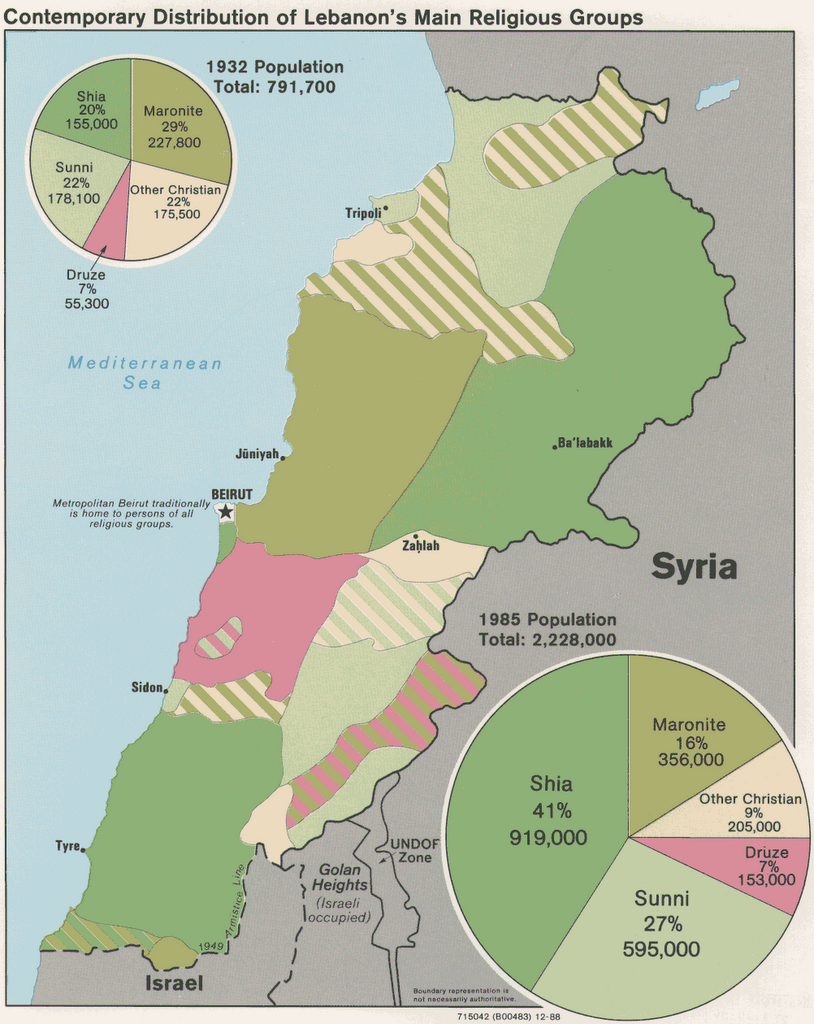
Irritating Statement #3: “blah blah disputed Shabaa farms blah blah blah,” every radio report about ceasefire conditions etc. Did Lebanon complain about this nigh-uninhabited strip on the border before 1967, when it was administered by Syria? Did Lebanon complain about it at any time between 1967 and 1982, when it was occupied by Israel as conquered Syrian territory? Did Lebanon complain when the United Nations drew up the maps to accompany resolution 1559? No, no, and no. Nobody had ever heard of the Shabaa Farms before Hezbollah seized on them in 2000 as a convenient excuse to continue an armed struggle with Israel. Can a territory be considered disputed if a fringe group suddenly pipes up and claims it for one country rather than another? Only if the rest of the world takes them seriously. So they shouldn’t. The rest of the world, that is.

A Consummation Devoutly to be Wished

From Radio National, Augusat 7th:

Michael Duffy: Are there any rock lyricists or song writers that you particularly admire?


Mark Steyn: Funnily, there are, there's Sting. I think he writes very good songs and I once ran into him in London, and we were having...funnily enough, just like earlier, we were talking about PG Wodehouse lyrics who he knew about and was rather partial to. I said how much I had liked some of his early hits with the Police, like 'Every Breath You Take' and things like that, I said I was thinking of making an album called Songs for Stingin' Lovers where I was going to do great big swingin' big-band arrangements of Sting songs. The colour drained from his face and I think if I'd pursued it any further he would have contacted his lawyer, but I still have that as a project in the back of my mind somewhere.