I can't find the article I was looking for- I remember reading it somewhere. I thought it was by Amir Taheri, but I can't find it now. The idea was that the tired old revolutionary government in Iran was supporting terrorism in order to distract the people from their problems by demonised externnal enemies, while the fresh-faced revolutionary guard Ahmadijenad has an ambitious domestic reform agenda and doesn't need to scare up bogeymen and engage in military adventures in places like Lebanon. But the article I found just now doesn't seem to say that at all, so it was probably somebody else.
Maybe Iran with nuclear weapons wouldn't go around with such a chip on its shoulder making rash rhetorical statements. Maybe it wouldn't bother giving Hizbullah teensy little rockets to lob into the Galilee if it knew that if it really, really felt like it it could go the whole hog and blow all of Israel up. Maybe a India-sized nuclear arsenal would settle it down a bit. Just a Pollyannaish thought...
And, another thing that might make Iran settle down and become a more responsible state would be the strain of fighting a proxy war against the Sunni insurgency in its Iraqi client state... I expect it would forget all about exporting Islamic Democracy to the world then! So it's all good, whatever happens...
Friday, September 23, 2005


Friday, September 16, 2005
WTF?
I am bothered by this Scott Parkin deportation thing. What is this guy supposed to have done that merits an $11,000 fine without any legal proceedings? Why won't anyone tell us? Surely it is a breach of our bilateral free trade agreement to protect our local peace activist industry by deporting American ones.
You all know that I am naively trusting of our government, and I would be satisfied with a transparent excuse; even if Alexander Downer said 'Sorry, they're a law of their own in that department, we haven't got a clue what they're doing... I don't want to make any comments on the record, in case they deport me.' I'd be happy with that. But we haven't been told anything.
You all know that I am naively trusting of our government, and I would be satisfied with a transparent excuse; even if Alexander Downer said 'Sorry, they're a law of their own in that department, we haven't got a clue what they're doing... I don't want to make any comments on the record, in case they deport me.' I'd be happy with that. But we haven't been told anything.
Saturday, September 10, 2005
Why the War was Wrong, Part the Third
Raimond Gaita knows what absolute morality is, and appeals to the long tradition- quoting Socrates and St. Paul- that weighing the consequences of what we do yields only a partial moral understanding of it. He could use this to rigorously define, on the basis of this tradition, a coherent philosophy that it is better to suffer evil than inflict it, and condemn all war. However, he is wise enough to realise that one may inflict evil by inaction, as well as action. “Almost everyone now agrees that our failure to intervene militarily in Rwanda shamed us all.”
He says something that I think is very true: “Memory of the forsaken Tutsis has haunted argument about whether the the world should have intervened on behalf of Saddam’s victims” – I think this has been an important psychological factor certainly in US foreign policy, and I think the interventions in Yugoslavia and East Timor, for instance, would have been less likely to happen without the example of Rwanda. Gaita works hard to draw a clear distinction between the cases of Iraq and Rwanda:
The problem with this attempt to draw a distinction is that it is too subjective to be useful. What is the touchstone for deciding whether the victims can ‘justifiably claim that our refusal has wronged them’? According to the absolute morality which Osama bin Laden lives by, Palestinian muslims can justifiably claim that the governments of Egypt and Saudi Arabia have wronged them by not driving the Jews into the sea: he gets quite irate about it. Lots of people agree with him. To my way of thinking, the aborted millions of the United States have a justifiable claim that the refusal of decent folk to rise up in arms against the culture of death has wronged them. What does Gaita suggest as an objective principle for differentiating a justifiable from an unjustifiable claim? I could find nothing.
I would argue that whenever it was possible for us to do something, and we didn’t, the victims of our inaction have a justifiable claim against us. Whenever it was possible for us to do something, and we did, the victims of our action likewise have a justifiable claim against us. Countless people will have justifiable claims against us at all times: there is no way we can ever be blameless. We have to balance these competing justifiable claims as best we can.
Gaita asks, ‘what do we think we are, to have taken this upon ourselves?’.
‘Eritis sicut deus, scientes bonum et malum.’
That is what we are. We are humans, with the knowledge of good and evil, and the question ‘by what right can we take this upon ourselves?’ will never magically fade away. There is no objective process of ‘necessitation’ that removes from us the evil we do. If we had invaded Rwanda, there would have been ‘collateral damage’; there would have been atrocities perpetrated in turn by the Tutsis on the Hutus that would not have happened if we had not invaded. We would have had to look at these things and accept the blame for them. Were we right to fight the Nazis? We were not obligated to, in the way the Poles were. We could not predict the consequences of our intervention in 1939 with any certainty whatsoever. Maybe things would have turned out better if we had let Hitler and Stalin keep Poland. We don’t know. I think we were right to fight the Nazis, but that certainly doesn’t mean that we ‘don’t have to look at the corpses on one side and the joyfully liberated on the other’. We have to look at Dresden and accept the blame for it. It is our duty as human beings.
Peter Coghlan (Senior Lecturer in Philosophy, Australian Catholic University), takes up Gaita’s argument, and also has a go at drawing the distinction, in a way that I think is more fruitful:
I think there is a lot of truth in this argument. The interesting thing about it is that in clarifying what is meant by ‘necessitation’ it turns the idea of ‘necessitation’ on its head. We might be forced into war by an invasion by a massively superior force- in such a case, where we have no hope of success, it would be wrong to fight. But if we possess overwhelming force and can reduce the uncertainty attendant on humanitarian military intervention to near zero, then we ought to intervene...the more a war becomes a ‘war of choice’, by Coghlan’s argument, the more it is morally justifiable! Coghlan does not of course say this, and after conceding that Iraq’s military was obviously no threat to the US, he says there was no compelling obligation to go to war.
Where there is a nasty regime that is down on its luck and has no power and no friends- and Iraq satisfies that criterion much more than the icky regimes of Zimbabwe (regional superpower South Africa = friend), or Burma (ASEAN = friend), or Turkmenistan (Russia = friend)- then it becomes a moral imperative to sink the boot in. Are you guys comfortable with this distinction? I’m not entirely sure that I am. But it is the only clear objective distinction between Rwanda 1994 and the Soviet Union 1932-1933. Coghlan recognises that Iraq was weak, but Coghlan has consciously or unconsciously shied away from the implications of his argument by his choice of dates: the more relevant example from Stalin’s era is really 1945-1946, when he continued to engage in practices just as hideous as 1932-1933, but was at the mercy of the world’s sole nuclear power.
An interesting corollary of Coghlan’s attempt to make a black/white distinction is the effect of public opinion- if your nation has the resources and political will to wage a humanitarian war, then claiming it is immoral and protesting against it may weaken the probability that the war will fulfill its humanitarian aims, and hence make it into an immoral war!
I concede the field to Socrates and St. Paul, and accept that the invasion of Iraq was wrong. Likewise, an invasion of Rwanda would have been wrong, the invasion of Cambodia was wrong, and the invasion of Germany was wrong. But then I think everything is wrong, in my lucid moments.
‘Why the War was More Wrong than the Other Possible Courses of Action in 2002-2003’ does not make a catchy title for a book, but that is really what the contributors to the volume are trying to say. Clearly the suffering and loss of human potential attendant on the invasion of Iraq was bad. Clearly we can imagine ‘less wrong’ courses of action practicable in 2002-2003. Thousands of miles away and years afterwards, we can all sit back and think of them.
However: the real question for citizens of countries like ours- not the country driving the policy, but the ones invited to contribute- is: ‘Of the choices available to our nation at this moment, which is the least wrong?’ There were only two reasonably coherent plans proposed at the time:
(1) Removing Saddam Hussein by force, or
(2) Maintaining the existing regime of sanctions and inspections.
We had to chose one of these, and in our small way, try to move it in a ‘less wrong’ direction. The Australian and British rules of engagement saved civilian lives. The war would have been more successful and less deadly to civilians with a larger Australian involvement. The war would have happened anyway, even if our Prime Minister had been a xenophobic bogan. What would we have achieved by opposing it?
He says something that I think is very true: “Memory of the forsaken Tutsis has haunted argument about whether the the world should have intervened on behalf of Saddam’s victims” – I think this has been an important psychological factor certainly in US foreign policy, and I think the interventions in Yugoslavia and East Timor, for instance, would have been less likely to happen without the example of Rwanda. Gaita works hard to draw a clear distinction between the cases of Iraq and Rwanda:
“Sometimes an obligation falls upon any decent nation to attack another sovereign nation for the sake of those against whom the latter commits crimes against humanity. But no one can sanely believe that we are morally bound to attack every nation guilty of that crime, nor even every nation guilty of genocide as defined in the United Nations Convention of 1948. ... In the context of anything that looks like the present state of international relations, a (moral) obligation to go to war exists when our refusal to do so for the sake of the persecuted is rightly seen by them as abandonment- when, in other words, they can justifiably claim that our refusal has wronged them. Rwanda satisfies that criterion. Zimbabwe does not. Neither, I believe, did Iraq.”
...
“If we go to war not because we are obliged to but in order to bring about a humanitarian benefit- to save more lives, for example, than we estimate would be lost at our hands because we have intervened- then we must answer the question: “Who do we think we are- what do we think we are- to have taken this upon ourselves?” We must answer this question even if, as is hardly ever the case, we can have reasonable confidence in the consequences of our intervention. What kind of reply can we make to our victims, or to those who mourn them? That it is all for the best? That, all things considered, it is worth it?
Obligations can take the form of necessity. When we are lucidly obliged to go to war we can justifiably say that we will go because it is necessary, a necessity whose moral character is best (if clumsily) expressed with a double negative we could not not go. Then, I believe, the question,’ With what right have we taken this upon ourselves?’ falls away and with it the language of justification that is characteristic of replies to it. If we are necessitated, we do not have to look at the corpses on one side and the joyfully liberated on the other, or find that the words ‘it was worth it’ stick to our tongues.”
The problem with this attempt to draw a distinction is that it is too subjective to be useful. What is the touchstone for deciding whether the victims can ‘justifiably claim that our refusal has wronged them’? According to the absolute morality which Osama bin Laden lives by, Palestinian muslims can justifiably claim that the governments of Egypt and Saudi Arabia have wronged them by not driving the Jews into the sea: he gets quite irate about it. Lots of people agree with him. To my way of thinking, the aborted millions of the United States have a justifiable claim that the refusal of decent folk to rise up in arms against the culture of death has wronged them. What does Gaita suggest as an objective principle for differentiating a justifiable from an unjustifiable claim? I could find nothing.
I would argue that whenever it was possible for us to do something, and we didn’t, the victims of our inaction have a justifiable claim against us. Whenever it was possible for us to do something, and we did, the victims of our action likewise have a justifiable claim against us. Countless people will have justifiable claims against us at all times: there is no way we can ever be blameless. We have to balance these competing justifiable claims as best we can.
Gaita asks, ‘what do we think we are, to have taken this upon ourselves?’.
‘Eritis sicut deus, scientes bonum et malum.’
That is what we are. We are humans, with the knowledge of good and evil, and the question ‘by what right can we take this upon ourselves?’ will never magically fade away. There is no objective process of ‘necessitation’ that removes from us the evil we do. If we had invaded Rwanda, there would have been ‘collateral damage’; there would have been atrocities perpetrated in turn by the Tutsis on the Hutus that would not have happened if we had not invaded. We would have had to look at these things and accept the blame for them. Were we right to fight the Nazis? We were not obligated to, in the way the Poles were. We could not predict the consequences of our intervention in 1939 with any certainty whatsoever. Maybe things would have turned out better if we had let Hitler and Stalin keep Poland. We don’t know. I think we were right to fight the Nazis, but that certainly doesn’t mean that we ‘don’t have to look at the corpses on one side and the joyfully liberated on the other’. We have to look at Dresden and accept the blame for it. It is our duty as human beings.
Peter Coghlan (Senior Lecturer in Philosophy, Australian Catholic University), takes up Gaita’s argument, and also has a go at drawing the distinction, in a way that I think is more fruitful:
‘Can we stand by and watch as the citizens of an entire nation are treated as raw material in an insane and fanatical drive to create a new form of society- indeed, in the perverted minds of the Khmer Rouge, a new form of human being? Can we stand by and watch evil on such a terrifying scale? ... In a case like this, the victims of such horrors cannot rightly say that we betrayed them by not intervening on their behalf. But they can justifiably say that we failed them- that we could have protected them when they had been driven by their persecutors to the very margins of human existence but did not. It is that just claim which may generate an obligation to go to war on their behalf. That obligation falls in the first instance on the community of nations in the UN. But if the UN fails in its duty, then the obligation falls on any group of nations, or any single nation, which has the capacity to gelp through armed intervention.
Yet there are surely limits to such claims and the obligations they generate. What of the people of the Ukraine in the period from 1932 to 1933 when Stalin deliberately engineered a famine to break their spirit- a famine which cost seven million lives? Assume that we had accurate information about the extent of the horror. Would the Ukrainians have had a just claim on us to wage war on their behalf?
I think the answern has to be no. The reason is clear. The west could not have intervened on behalf of the Ukrainians without precipitating a conflict with the Red Army; and the outcome of the conflict could not have been predicted. A defeat at the hands of the Red Army would have been a real possibility. Then we would have lost on both counts: our forces would have suffered terrible casualties and we would have failed the Ukrainians anyway.
So, here, the radical uncertainty that often attends on humanitarian military intervention does make a difference to our moral judgment. We might have had a reasonable hope of success in protecting the Cambodians had we chosen to invade that country during Pol Pot’s rule. But wehen we are faced with a major military power, our chances of success are obviously weakened. In the nuclear age, they may be weakened to the point where we cannot act without precipitating a conflagration involving the deaths of many millions. That is why, to return to two earlier cases, we would be justifed in refusing any cries for military intervention- cries made in the name of our common humanity- of the Chechens and Tibetans.’
I think there is a lot of truth in this argument. The interesting thing about it is that in clarifying what is meant by ‘necessitation’ it turns the idea of ‘necessitation’ on its head. We might be forced into war by an invasion by a massively superior force- in such a case, where we have no hope of success, it would be wrong to fight. But if we possess overwhelming force and can reduce the uncertainty attendant on humanitarian military intervention to near zero, then we ought to intervene...the more a war becomes a ‘war of choice’, by Coghlan’s argument, the more it is morally justifiable! Coghlan does not of course say this, and after conceding that Iraq’s military was obviously no threat to the US, he says there was no compelling obligation to go to war.
‘The stark truth is that there are many countries like Iraq, and many peoples who are living under oppression and persecution, terrorised and brutaslised by the apparatus of the police state- and subject every now and then to mass murder. Zimbabwe ... North Korea ... Burma ... Turkmenistan. The peoples of all these nations- and more- could aly claim in the name of our common humanity to our military intervention to come and liberate them. And, in every case except perhaps that of North Korea, we would have reasonable grounds for thinking that our intervention would be successful. ... And the international community simply does not have the resources to tackel all these cases. So deciding which cases demand an armed response is a matter of judgment. Typically that judgment is determined by other factors besides humanitarian concerns.’
Where there is a nasty regime that is down on its luck and has no power and no friends- and Iraq satisfies that criterion much more than the icky regimes of Zimbabwe (regional superpower South Africa = friend), or Burma (ASEAN = friend), or Turkmenistan (Russia = friend)- then it becomes a moral imperative to sink the boot in. Are you guys comfortable with this distinction? I’m not entirely sure that I am. But it is the only clear objective distinction between Rwanda 1994 and the Soviet Union 1932-1933. Coghlan recognises that Iraq was weak, but Coghlan has consciously or unconsciously shied away from the implications of his argument by his choice of dates: the more relevant example from Stalin’s era is really 1945-1946, when he continued to engage in practices just as hideous as 1932-1933, but was at the mercy of the world’s sole nuclear power.
An interesting corollary of Coghlan’s attempt to make a black/white distinction is the effect of public opinion- if your nation has the resources and political will to wage a humanitarian war, then claiming it is immoral and protesting against it may weaken the probability that the war will fulfill its humanitarian aims, and hence make it into an immoral war!
I concede the field to Socrates and St. Paul, and accept that the invasion of Iraq was wrong. Likewise, an invasion of Rwanda would have been wrong, the invasion of Cambodia was wrong, and the invasion of Germany was wrong. But then I think everything is wrong, in my lucid moments.
‘Why the War was More Wrong than the Other Possible Courses of Action in 2002-2003’ does not make a catchy title for a book, but that is really what the contributors to the volume are trying to say. Clearly the suffering and loss of human potential attendant on the invasion of Iraq was bad. Clearly we can imagine ‘less wrong’ courses of action practicable in 2002-2003. Thousands of miles away and years afterwards, we can all sit back and think of them.
However: the real question for citizens of countries like ours- not the country driving the policy, but the ones invited to contribute- is: ‘Of the choices available to our nation at this moment, which is the least wrong?’ There were only two reasonably coherent plans proposed at the time:
(1) Removing Saddam Hussein by force, or
(2) Maintaining the existing regime of sanctions and inspections.
We had to chose one of these, and in our small way, try to move it in a ‘less wrong’ direction. The Australian and British rules of engagement saved civilian lives. The war would have been more successful and less deadly to civilians with a larger Australian involvement. The war would have happened anyway, even if our Prime Minister had been a xenophobic bogan. What would we have achieved by opposing it?
Thursday, September 01, 2005
Why the War was Wrong, Part the Second
winstoninabox saith:
According to Robert Manne, the UN Charter ‘prohibits the use of force except in two circumstances: when authorised by the UN Security Council under Chapter VII of the Charter; and in self-defence when an armed attack occurs or is imminent.’ As a founding member, the US would have to have endorsed the charter, so winstoninabox has hit the nail on the head: it is, by definition, wrong to break your promises and be a sneaky lying weasel. Thus the legal prohibition acquires moral force as well, and I must accept that the war was wrong in a slightly less narrow sense. The honourable thing to do would have been to quit the UN before invading, after the failure of all the feverish and probably counterproductive diplomatic activity trying to get UN Security Council authorisation.
"What are these procedures?
As a UN member had the US agreed to follow them, or like the pirate's code, are they more like guidelines?"
According to Robert Manne, the UN Charter ‘prohibits the use of force except in two circumstances: when authorised by the UN Security Council under Chapter VII of the Charter; and in self-defence when an armed attack occurs or is imminent.’ As a founding member, the US would have to have endorsed the charter, so winstoninabox has hit the nail on the head: it is, by definition, wrong to break your promises and be a sneaky lying weasel. Thus the legal prohibition acquires moral force as well, and I must accept that the war was wrong in a slightly less narrow sense. The honourable thing to do would have been to quit the UN before invading, after the failure of all the feverish and probably counterproductive diplomatic activity trying to get UN Security Council authorisation.
Saturday, August 27, 2005
Why the War was Wrong, Part the First
What does Robert Manne say? (I am only starting with him because his is the first essay in the book. It says in the introduction that he is Professor of Politics at *ahem* Latrobe, and –as you doubtless know- a columnist for the Age and the Devil Bunny City Morning Herald.)
“The danger of this conflation of the pre-emptive strike and preventive war was aggravated precisely by the fact that ... the US reserved for itself the right to strike unilaterally without mandate from the established procedures of the United Nations. ...the US not only reserved for itself the right to go to war on the basis of an imagined threat. It also arrogated to itself the exclusive right to decide when and where such a threat existed.
... If all states possessed this right, the Bush doctrine opened the way for a return to the law of the jungle, where the powerful have the capacity to impose their will on the weak. If, on the other hand, the right did not exist for other states, the Bush doctrine amounted to an almost formal claim to US world hegemony.”
This is as close as Robert Manne comes in his essay to explaining why the 2003 War was wrong. What is his assumption, that we must share in order to accept his argument? I believe it is this: The United Nations has moral authority over the nations that comprise it.
What is the United Nations? The United Nations itself is simply another manifestation of the law of the jungle Manne talks about. The United Nations is an institution imposed by the victors in the last World War in order to impose their collective will upon the vanquished. The law of the jungle has never gone away, so it cannot return: all states have, in practice, always behaved in the way Manne paints as a new and disturbing innovation of President Bush. Their leaders, for good or- generally- evil, decide for themselves where a threat to their state exists and what they should do about it. The powerful do indeed, and will as long as the words ‘powerful’ and ‘weak’ have any meaning, have the capacity to impose their will upon the weak. The United Nations has no standing army, and so it cannot stop them, whatever legal authority it may have.
What is the United Nations? It is the sum of the states that compose it, all of which are institutions imposed by force upon unwilling or compliant individual human beings. Some of these states are halfway decent, most of them are not, some of them are awful. Without exception these abstractions called states have magnified their importance to a fantastic and obscene degree over the importance of real, non-abstract entities called individual human beings. ‘Legality’ is what each state says it is, and ‘internationl law’ is what they have collectively decided it is. Some laws are in reasonable accord with reason and morality, some are less so, and some are awful. According to the rules of the United Nations, the Vietnamese invasion of Cambodia was illegal, and Pol Pot’s regime continued to occupy Cambodia’s seat in the United Nations for a decade. I accept that the Anglospherican invasion of Iraq was illegal, in exactly the same way that Vietnam’s invasion of Cambodia was illegal. This is not relevant to the question of whether it was right or wrong.
Hilary Charlesworth (Profesosr of International Law at the Australian National University) demonstrates entirely convincingly- as you would expect a Professor at a real university to do- that the invasion was, according to the accepted principles of international law, illegal.
Eva Sallis (an Australian-born writer) communicated her emotional state in a most satisfactory way, as one expects a novelist to do, but presented no rational argument that I could find.
The next essay, by Raimond Gaita (Professor of Moral Philosophy, University of London and the Australian Catholic University) seems rather more coherent from the first few pages- although it reads disturbingly as though it might have been written by myself, Dr Clam. Knowing my own formidable powers, I therefore expect it will convince me, so I bid you farewell from what may well be my last ‘pro-war’ post!
“The danger of this conflation of the pre-emptive strike and preventive war was aggravated precisely by the fact that ... the US reserved for itself the right to strike unilaterally without mandate from the established procedures of the United Nations. ...the US not only reserved for itself the right to go to war on the basis of an imagined threat. It also arrogated to itself the exclusive right to decide when and where such a threat existed.
... If all states possessed this right, the Bush doctrine opened the way for a return to the law of the jungle, where the powerful have the capacity to impose their will on the weak. If, on the other hand, the right did not exist for other states, the Bush doctrine amounted to an almost formal claim to US world hegemony.”
This is as close as Robert Manne comes in his essay to explaining why the 2003 War was wrong. What is his assumption, that we must share in order to accept his argument? I believe it is this: The United Nations has moral authority over the nations that comprise it.
What is the United Nations? The United Nations itself is simply another manifestation of the law of the jungle Manne talks about. The United Nations is an institution imposed by the victors in the last World War in order to impose their collective will upon the vanquished. The law of the jungle has never gone away, so it cannot return: all states have, in practice, always behaved in the way Manne paints as a new and disturbing innovation of President Bush. Their leaders, for good or- generally- evil, decide for themselves where a threat to their state exists and what they should do about it. The powerful do indeed, and will as long as the words ‘powerful’ and ‘weak’ have any meaning, have the capacity to impose their will upon the weak. The United Nations has no standing army, and so it cannot stop them, whatever legal authority it may have.
What is the United Nations? It is the sum of the states that compose it, all of which are institutions imposed by force upon unwilling or compliant individual human beings. Some of these states are halfway decent, most of them are not, some of them are awful. Without exception these abstractions called states have magnified their importance to a fantastic and obscene degree over the importance of real, non-abstract entities called individual human beings. ‘Legality’ is what each state says it is, and ‘internationl law’ is what they have collectively decided it is. Some laws are in reasonable accord with reason and morality, some are less so, and some are awful. According to the rules of the United Nations, the Vietnamese invasion of Cambodia was illegal, and Pol Pot’s regime continued to occupy Cambodia’s seat in the United Nations for a decade. I accept that the Anglospherican invasion of Iraq was illegal, in exactly the same way that Vietnam’s invasion of Cambodia was illegal. This is not relevant to the question of whether it was right or wrong.
Hilary Charlesworth (Profesosr of International Law at the Australian National University) demonstrates entirely convincingly- as you would expect a Professor at a real university to do- that the invasion was, according to the accepted principles of international law, illegal.
Eva Sallis (an Australian-born writer) communicated her emotional state in a most satisfactory way, as one expects a novelist to do, but presented no rational argument that I could find.
The next essay, by Raimond Gaita (Professor of Moral Philosophy, University of London and the Australian Catholic University) seems rather more coherent from the first few pages- although it reads disturbingly as though it might have been written by myself, Dr Clam. Knowing my own formidable powers, I therefore expect it will convince me, so I bid you farewell from what may well be my last ‘pro-war’ post!
Wednesday, August 24, 2005
From Fred Hoyle's 'The Black Cloud'
'The two men were mentally too dissimilar for more than a half hour of conversation between them to be possible. When the Home Secretary talked, it was his aim to make those to whom he was talking react according to some pre-arranged plan. It was irrelevant to him how he succeeded in this, so long as he succeeded. ... For the most part, like other administrators, he found that arguments containing some deep-rooted emotional appeal, but couched in seemingly logical terms, were usually successful. For strict logic he had no use whatsoever. To Kingsley on the other hand strict logic was everything, or nearly everything.'
I am slowly working my way through a book called 'Why the War was Wrong', trying to figure out the rational arguments are, and hope to respond soon...
I am slowly working my way through a book called 'Why the War was Wrong', trying to figure out the rational arguments are, and hope to respond soon...
Saturday, August 20, 2005
Pax Americana
I'm not quite sure what Marco means when he says Pax Americana, but I mean what the phrase was coined for, something exactly analogous to the Pax Romana under the Four Good Emperors, but exhibiting the distinctive characteristics of American rather than Roman civilisation. "One world under God, with Liberty and Justice for All". In such a world I, selfishly, would not have to worry about my children being drafted to fight the barbarians, which is why it holds great appeal to me.
This Pax Americana is obviously something that is potential, not actual. Sadly, it does not seem to be approaching with any rapidity. All of the evidence is that the only potential World unifier and pacifier is sliding back more and more into short-sighted pragmatism. It is pathetic to see the most powerful nation on earth making feeble appeasy noises towards totally unimportant and vile organisations like Hamas. It is more pathetic to see it turning a blind eye to the actions of the 'friendly' regime of Uzbekistan. A good first step towards the establishment of the Pax Americana would have been the conquest and long-term occupation under Douglas Macarthur-style American rule of the five Middle Eastern places where some permutation of nihilist Anti-American islamofascism was an entrenched way of life: Palestine, Syria, Iraq, Iran, and Afghanistan. They should have started in the west and slowly rolled across to the east, like Alexander the Great. It is almost a pity that Al-Qaeda did not take out the White House as well: then there might have been sufficient political will to get and keep the required two million troops on the ground between the Mediterranean and the Indus. If this had happened, there would be a pretty good chance that the world would be a nice place ten years from now. But it hasn't.
In the last few months it has sunk in that things are moving much too slowly, and that I will just have to live with the fear that my children will be drafted to fight the barbarians. My father, grandfather, and great-grandfather all had to go off and fight the barbarians. I have been fortunate enough not to have. Maybe we will luck out and get two generations in a row. We shall see.
This Pax Americana is obviously something that is potential, not actual. Sadly, it does not seem to be approaching with any rapidity. All of the evidence is that the only potential World unifier and pacifier is sliding back more and more into short-sighted pragmatism. It is pathetic to see the most powerful nation on earth making feeble appeasy noises towards totally unimportant and vile organisations like Hamas. It is more pathetic to see it turning a blind eye to the actions of the 'friendly' regime of Uzbekistan. A good first step towards the establishment of the Pax Americana would have been the conquest and long-term occupation under Douglas Macarthur-style American rule of the five Middle Eastern places where some permutation of nihilist Anti-American islamofascism was an entrenched way of life: Palestine, Syria, Iraq, Iran, and Afghanistan. They should have started in the west and slowly rolled across to the east, like Alexander the Great. It is almost a pity that Al-Qaeda did not take out the White House as well: then there might have been sufficient political will to get and keep the required two million troops on the ground between the Mediterranean and the Indus. If this had happened, there would be a pretty good chance that the world would be a nice place ten years from now. But it hasn't.
In the last few months it has sunk in that things are moving much too slowly, and that I will just have to live with the fear that my children will be drafted to fight the barbarians. My father, grandfather, and great-grandfather all had to go off and fight the barbarians. I have been fortunate enough not to have. Maybe we will luck out and get two generations in a row. We shall see.
Sunday, August 07, 2005
Picture = 1000 Words
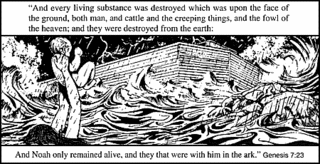
Having found where all the Jack Chick tracts are online, I couldn't stop at just one. I'm not sure if this is the exact panel, since this motif seems to recur in several of his tracts. But when I was a young fellow, I used to worry sometimes, 'What if what the evangelicals say is true'? Then I saw this panel, and I realised, 'It doesn't matter if it is true or not, it's wrong.' God isn't sending the rain down in the picture; God is standing in the water. And I'm with him, even if he doesn't exist, and our universe is at the mercy of some psycho looney God-wannabe.

Tuesday, August 02, 2005
Proportionate Response
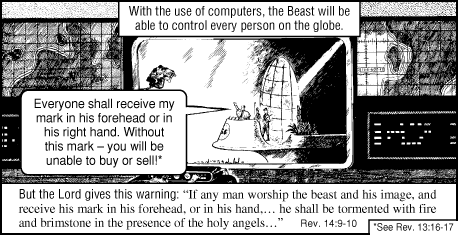
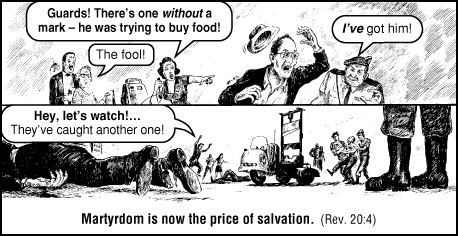
I've decided to respond to the recent moves to introduce a national identity card by over-reacting wildly and inappropriately, to a degree exactly proportionate to the extent that this proposal is a wild and inappropriate overreaction to the problems it is supposed to solve.


Wisdom from Dave
Quoth Dave: Extremes of opinion (informed, researched or otherwise) to my mind are frequently associated with extremes of emotional attachment to those opinions. As someone given to unreasonable behavioural modes in situations of extreme emotion, my inclination is towards the reserved end of the spectrum wherever possible. If you don't get involved in an issue, you can't get angry about it.
This is a very sensible comment- the motivation for Moderation may well be something far nobler than the desire to appear Solomonically wise and even-handed without putting any intellectual effort in, namely, the socially responsible desire not to kick somebody's head in. The principle of Moderation is obviously an easy way to achieve emotional distance from stressful issues, especially ones you don't have a particularly desire to think about anyway. I suppose I am happy with Moderation as long as it is a politically-correct cloak over one's real extremist opinions, and does not conceal a mere absence of thought. My habitual method for maintaining emotional distance from arguments that might unsettle me is the somewhat more entertaining Taking the Piss method, e.g.: If I fell into the middle of an online argument between fanatical Zionists and hard-core Palestinian rejectionists, I would do my best to argue- drawing on my meager knowledge of the Book of Mormon- that God had actually promised their land to the Arapaho Indian Nation. I was tempted to do something just like this when I found the Nagorno-Karabakh flame wars on Wikipedia.
Furthermore, quoth Dave, speaking of the Buffster: The oddly upbeat finale does raise an interesting question: for the first time in 7 years (not counting her brief flirtation with lucidity in the episode where the Truth is Revealed) Buffy is happy - or at least satisfied - her issues are resolved and her angsty "only I can save the world" mission is no longer hers alone. Does this utterly out-of-context end to the foundations of her fantasy existence point to a full recovery from her coma? I'd like to think so.
So would I- there is a beautiful symmetry in how Buffy first creates Sunnydale as a 'safe' place to escape from her stressful experience in Los Angeles. It very rapidly became a place that was not safe at all (well before the end of the first episode), but she was unable pull herself away from it; in the end, it is only when it is destroyed that she can be sane again.
This is a very sensible comment- the motivation for Moderation may well be something far nobler than the desire to appear Solomonically wise and even-handed without putting any intellectual effort in, namely, the socially responsible desire not to kick somebody's head in. The principle of Moderation is obviously an easy way to achieve emotional distance from stressful issues, especially ones you don't have a particularly desire to think about anyway. I suppose I am happy with Moderation as long as it is a politically-correct cloak over one's real extremist opinions, and does not conceal a mere absence of thought. My habitual method for maintaining emotional distance from arguments that might unsettle me is the somewhat more entertaining Taking the Piss method, e.g.: If I fell into the middle of an online argument between fanatical Zionists and hard-core Palestinian rejectionists, I would do my best to argue- drawing on my meager knowledge of the Book of Mormon- that God had actually promised their land to the Arapaho Indian Nation. I was tempted to do something just like this when I found the Nagorno-Karabakh flame wars on Wikipedia.
Furthermore, quoth Dave, speaking of the Buffster: The oddly upbeat finale does raise an interesting question: for the first time in 7 years (not counting her brief flirtation with lucidity in the episode where the Truth is Revealed) Buffy is happy - or at least satisfied - her issues are resolved and her angsty "only I can save the world" mission is no longer hers alone. Does this utterly out-of-context end to the foundations of her fantasy existence point to a full recovery from her coma? I'd like to think so.
So would I- there is a beautiful symmetry in how Buffy first creates Sunnydale as a 'safe' place to escape from her stressful experience in Los Angeles. It very rapidly became a place that was not safe at all (well before the end of the first episode), but she was unable pull herself away from it; in the end, it is only when it is destroyed that she can be sane again.
Sunday, July 31, 2005
How to Make Our Ideas Muddled
You are probably aware of Charles Sanders Peirce’s four ways of forming and holding an opinion, outlined in 'How to Make Our Ideas Clear’. These are:
(1) Tenacity. Sticking to what you happen to believe and ignoring anything that might change your mind.
(2) Authority: Picking someone who knows more than you do and believing what they tell you to.
(3) A Priori Reasoning: Working out a couple of core axioms with like-minded friends and extrapolate everything you need to believe from them.
(4) Experiment: Which as we all know, is the only one that really works.
I think there is another way, which is even more intellectually lazy than (1) and (2), since it saves the person using it from having to commit to anything. I call this despicable intellectual vice the habit of Moderation. If, when confronted with two vociferously argued points of view, you determine the arithmetic mean between the arguments you hear, and decide to hold those opinions, you are following this terminally lazy method. You can say that you are tolerant and wise, and that you can see the valid points in each side's argument, but you will be in the one place you can be sure to be totally useless, smugly suspended over the abyss between two coherent points of view.
I assert that the position that the great Sages and Prophets would recommend; the position that will seem self-evident to posterity; the position that will have the greatest chance, if adopted, of advancing understanding of the point of contention and solving it, will almost always be found in one of two places: (1) On or beyond the extreme fringe of one of the two opposing points of view, or (2) Somewhere completely removed from the continuum between parties A and B, beyond the limits of ‘known idea space’.
Consider the following long-forgotten arguments:
* Radical Abolitionists vs. Gradualists. By the end of the Civil War, the stated policy of the US Government was further to the extreme than all but a very few radical abolitionists had suggested at the War’s beginning.
* Containment vs. Détente. The premises of both fell apart.
* Leninism vs. Trotskyism. Ditto.
* Practically any argument at all from the history of science.
* Bundists vs. Zionists. In hindsight, the best course of action for the Jews of Poland would have been something only the most extreme Zionists of all advocated.
* Chalcedonians vs. Monophysites. For hundreds of years, the Eastern Roman Empire was convulsed by arguments between Chalcedonians and Monophysites. I’ve read hundreds of pages about the argument and am still not entirely sure what it was about. A series of decent and competent Emperors proposed compromise positions between them, all of which came to naught and serve only to complicate the catalogue of heresies. The problem was eventually ‘solved’ only by the conquest of the main Monophysite regions of the Empire by an ideology that rejected the premises of the argument in toto. Today, the page in my atlas where the world is mapped by traditional religious affiliation shows the successors of the two parties mapped in the same colour (pink), and the majority of the world’s Christians- as near as I can follow- belong to groups that are more Chalcedonian than the Chalcedonians.
(1) Tenacity. Sticking to what you happen to believe and ignoring anything that might change your mind.
(2) Authority: Picking someone who knows more than you do and believing what they tell you to.
(3) A Priori Reasoning: Working out a couple of core axioms with like-minded friends and extrapolate everything you need to believe from them.
(4) Experiment: Which as we all know, is the only one that really works.
I think there is another way, which is even more intellectually lazy than (1) and (2), since it saves the person using it from having to commit to anything. I call this despicable intellectual vice the habit of Moderation. If, when confronted with two vociferously argued points of view, you determine the arithmetic mean between the arguments you hear, and decide to hold those opinions, you are following this terminally lazy method. You can say that you are tolerant and wise, and that you can see the valid points in each side's argument, but you will be in the one place you can be sure to be totally useless, smugly suspended over the abyss between two coherent points of view.
I assert that the position that the great Sages and Prophets would recommend; the position that will seem self-evident to posterity; the position that will have the greatest chance, if adopted, of advancing understanding of the point of contention and solving it, will almost always be found in one of two places: (1) On or beyond the extreme fringe of one of the two opposing points of view, or (2) Somewhere completely removed from the continuum between parties A and B, beyond the limits of ‘known idea space’.
Consider the following long-forgotten arguments:
* Radical Abolitionists vs. Gradualists. By the end of the Civil War, the stated policy of the US Government was further to the extreme than all but a very few radical abolitionists had suggested at the War’s beginning.
* Containment vs. Détente. The premises of both fell apart.
* Leninism vs. Trotskyism. Ditto.
* Practically any argument at all from the history of science.
* Bundists vs. Zionists. In hindsight, the best course of action for the Jews of Poland would have been something only the most extreme Zionists of all advocated.
* Chalcedonians vs. Monophysites. For hundreds of years, the Eastern Roman Empire was convulsed by arguments between Chalcedonians and Monophysites. I’ve read hundreds of pages about the argument and am still not entirely sure what it was about. A series of decent and competent Emperors proposed compromise positions between them, all of which came to naught and serve only to complicate the catalogue of heresies. The problem was eventually ‘solved’ only by the conquest of the main Monophysite regions of the Empire by an ideology that rejected the premises of the argument in toto. Today, the page in my atlas where the world is mapped by traditional religious affiliation shows the successors of the two parties mapped in the same colour (pink), and the majority of the world’s Christians- as near as I can follow- belong to groups that are more Chalcedonian than the Chalcedonians.
Subscribe to:
Posts (Atom)